Earn points toward LEED and TRUE certification with Mill
This document explains how implementing Mill can help commercial properties achieve and maintain LEED (Leadership in Energy and Environmental Design) and TRUE (Total Resource Use and Efficiency) certifications. Mill provides an innovative, practical food recycling solution that contributes to point earnings in these certification programs while also delivering meaningful environmental and operational benefits.
Mill for LEED Certification: Mill can serve as a prerequisite for new construction project applications (BD+C, v5), or up to 6 points for existing buildings (O+M, v5)
Mill for TRUE Certification: Mill can apply toward up to 27 points (the difference between a Silver and Platinum score)
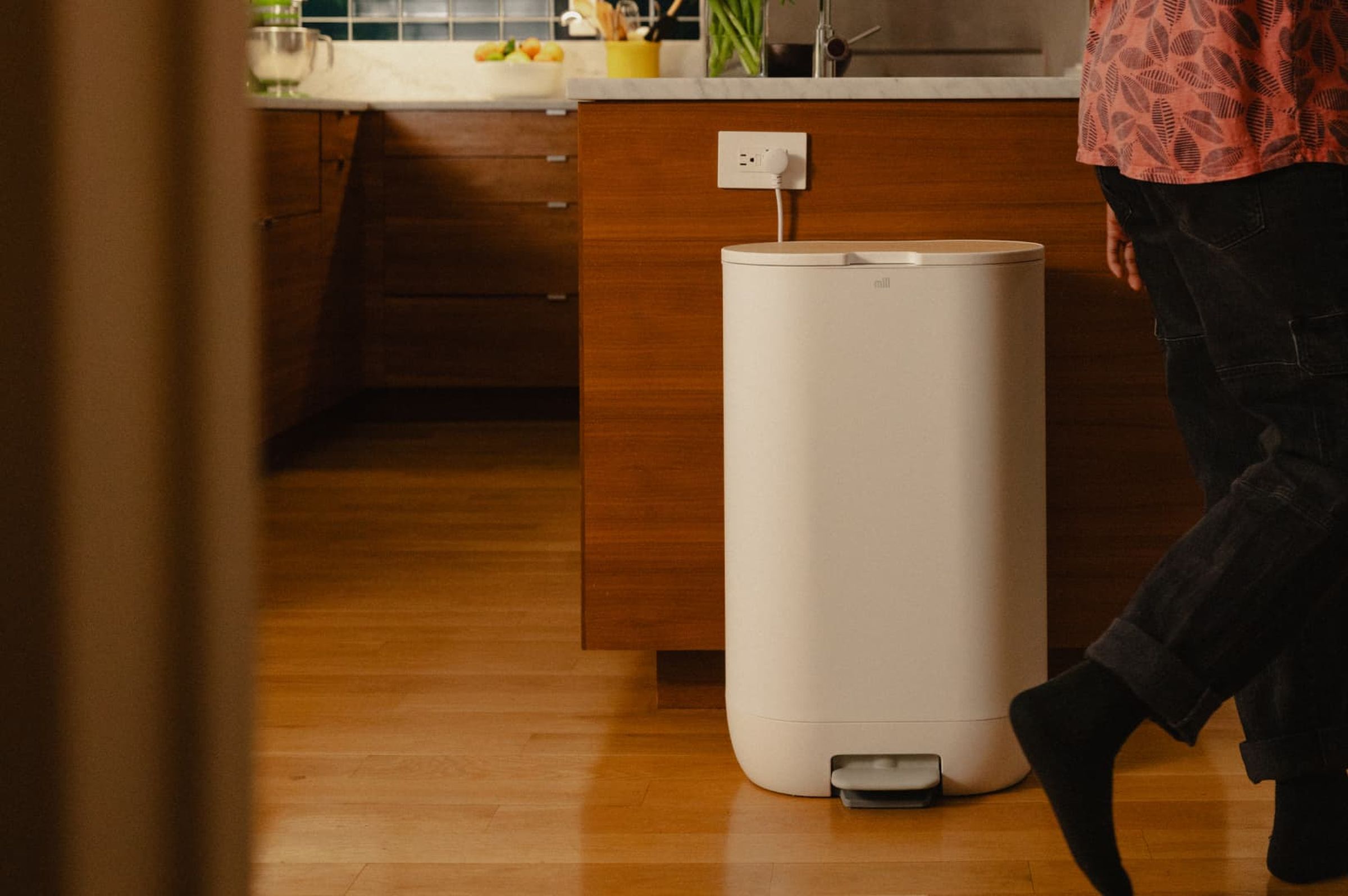
Mill provides an effortless, odorless solution for managing food waste in buildings. Throughout the day, employees and occupants simply add their food scraps, which are then ground and dehydrated overnight, reducing volume by up to 80%. Food scraps are transformed into nutrient-rich grounds that can be used in landscaping, added to organics bins, or repurposed as chicken feed. Mill’s connected software also tracks detailed data, giving building managers valuable insights into waste reduction and overall sustainability performance.
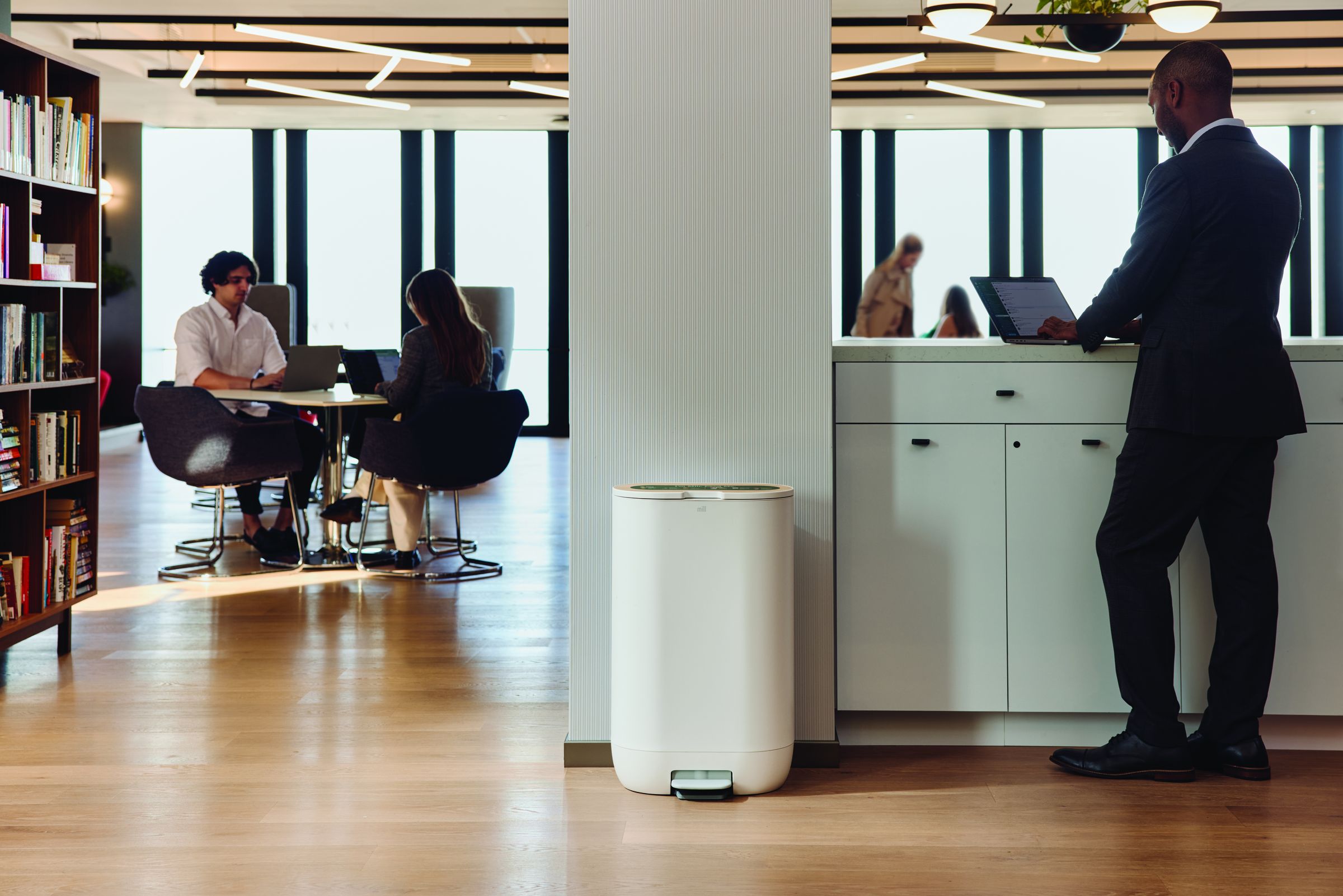
To maximize impact, place Mill in areas where food is consumed, including food service areas, breakrooms, kitchenettes, or loading docks/waste collection areas.
Data tracking: Automated measurement of food waste diversion helps with certification documentation
Space efficiency: Compact design requires minimal space compared to traditional collection methods
Odor elimination: Charcoal filter system prevents odors associated with traditional food waste collection
Pest prevention: Removes food waste that might attract pests
Clean kitchenettes: Less food waste in traditional trash improves overall building cleanliness
The U.S. Green Building Council (USGBC) sets sustainability standards such as LEED, and GBCI manages the certifications that put those standards into practice. As sister organizations, they collaborate to promote green building and deliver results that are both credible and measurable.
USGBC (U.S. Green Building Council)
A non-profit organization founded in 1993
Develops and maintains the LEED (Leadership in Energy and Environmental Design) green building rating system
Focuses on advocacy, education, and promoting sustainable building practices
Sets the standards and criteria for green building certification
GBCI (Green Business Certification Inc.)
Founded in 2008 as an extension of USGBC
The certification body that administers LEED and other sustainability certification programs
Handles the actual certification process, including verification, review, and awarding of credentials
Also administers other programs beyond LEED, such as WELL, SITES, PEER, TRUE, and GRESB
LEED (Leadership in Energy and Environmental Design) is the most widely used green building rating system globally, developed by the U.S. Green Building Council (USGBC). It provides a framework for creating healthy, highly efficient, and cost-saving green buildings. LEED certification is a globally recognized symbol of sustainability achievement and leadership.
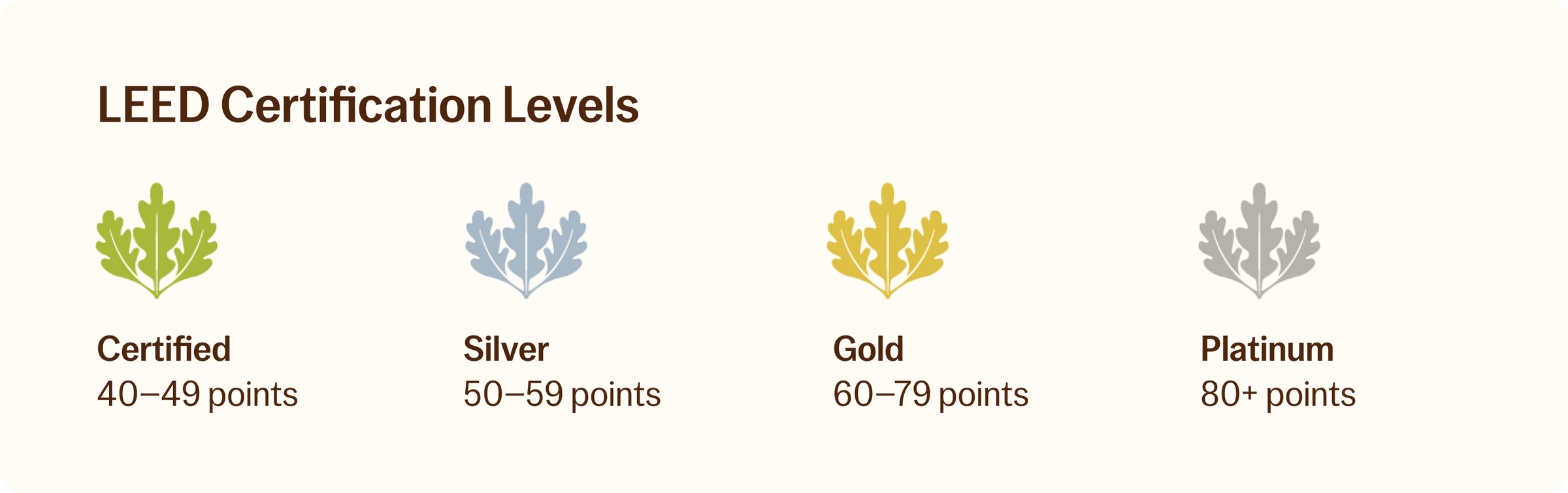
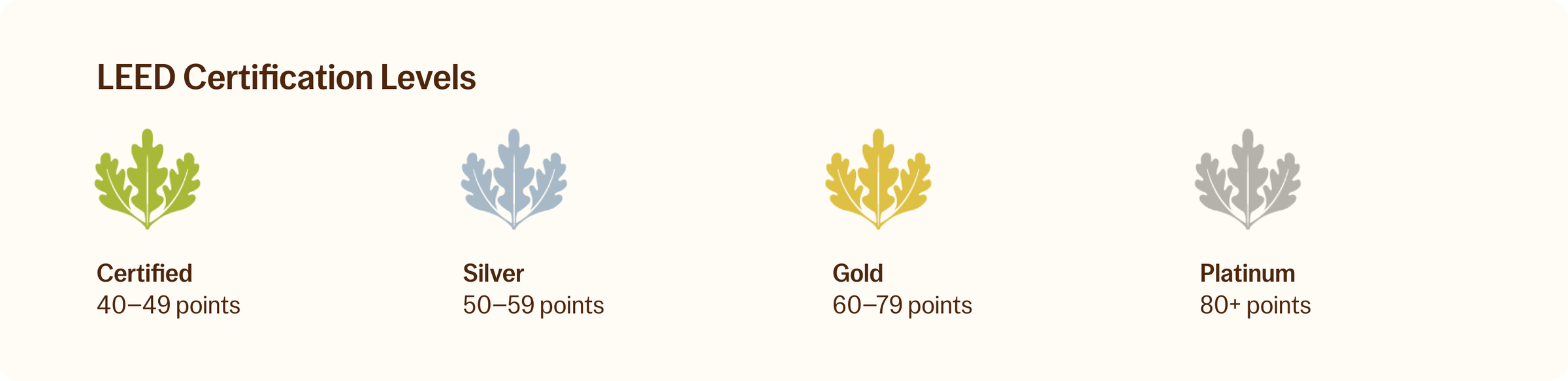
LEED offers four certification levels based on points earned:
Certified: 40-49 points
Silver: 50-59 points
Gold: 60-79 points
Platinum: 80+ points
Points are awarded across several categories including sustainable sites, water efficiency, energy and atmosphere, materials and resources, indoor environmental quality, and innovation.
Higher property values: LEED-certified buildings can command premium rental rates and higher resale values
Lower operating costs: Reduced energy and water consumption leads to significant operational savings
Enhanced marketability: Growing demand from environmentally conscious tenants
Healthier indoor environments: Better air quality and tenant well-being
Regulatory compliance: Increasingly important as municipalities adopt stricter sustainability requirements
Brand enhancement: Demonstrated commitment to environmental responsibility
TRUE (Total Resource Use and Efficiency) is a zero waste certification program administered by Green Business Certification Inc. (GBCI). TRUE certification is a leadership standard that helps facilities, organizations, events, and construction sites measure, improve and recognize zero waste performance by encouraging the adoption of sustainable resource management and reduction practices. TRUE projects divert 90% or more of their waste from landfill, incineration (waste-to-energy), and the environment.
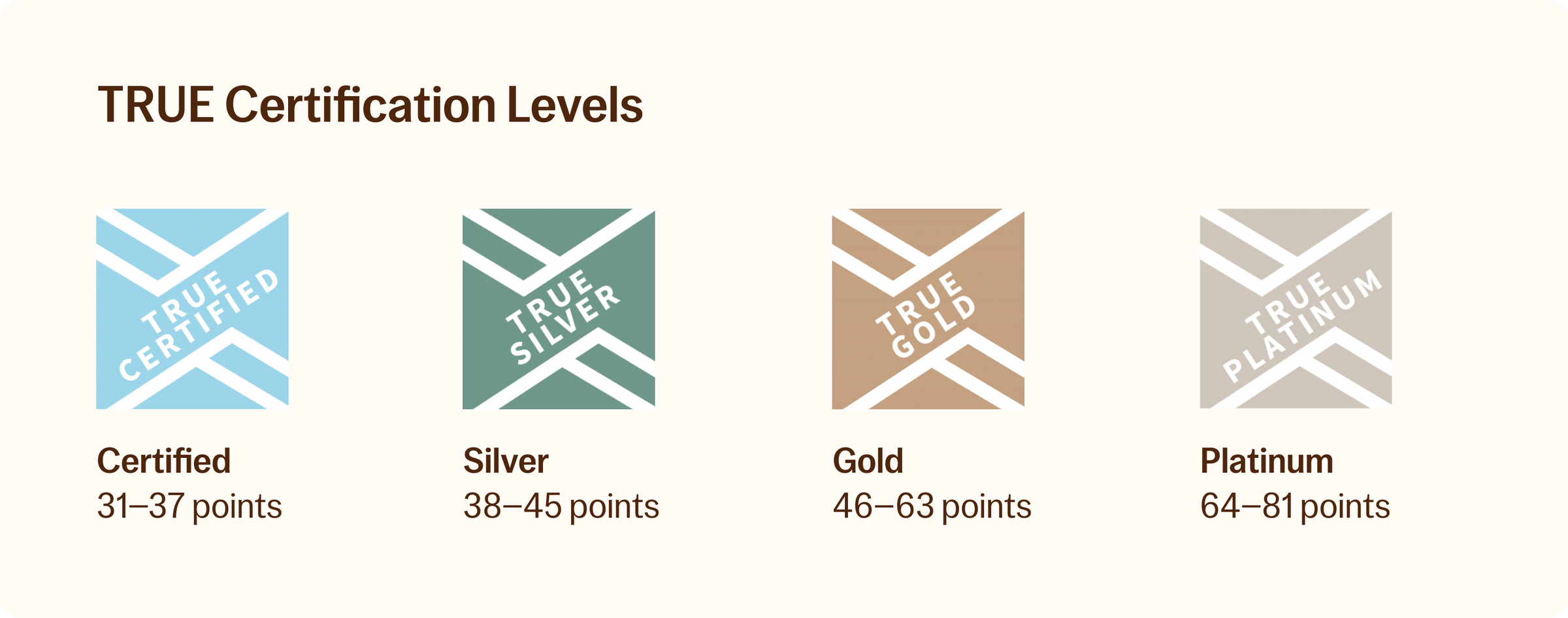
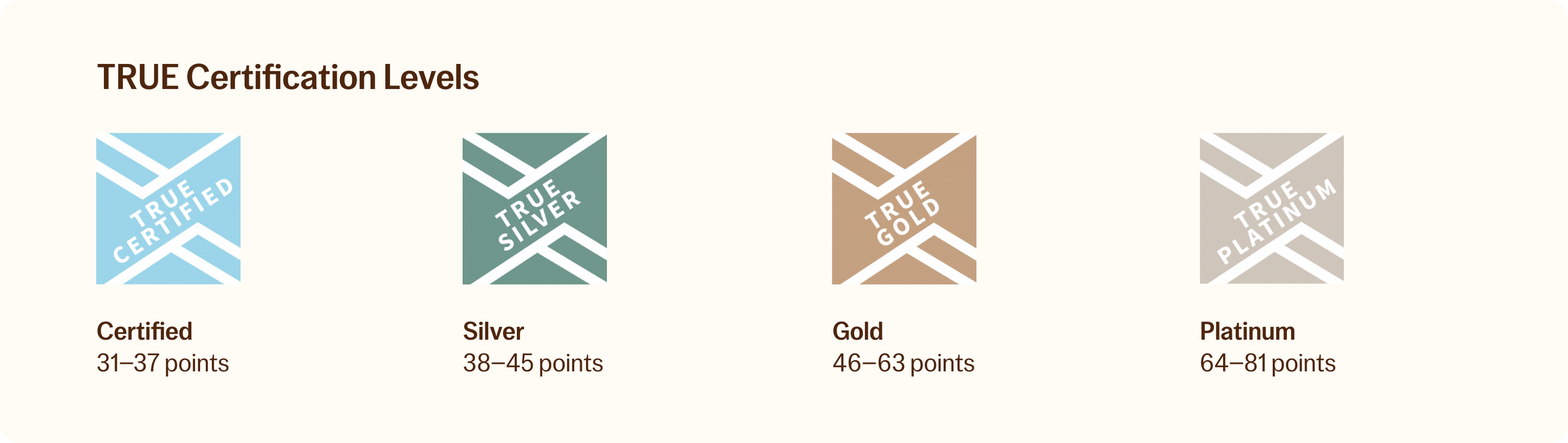
TRUE certification is available at four levels:
Certified: 31-37 points
Silver: 38-45 points
Gold: 46-63 points
Platinum: 64+ points
Cost savings: Reduced waste disposal expenses and potentially lower purchasing costs
Risk mitigation: Less vulnerability to supply chain disruptions and regulatory penalties
Employee engagement: Involvement in sustainability initiatives improves workplace satisfaction
Environmental leadership: Demonstrated commitment to reducing environmental impact
Complementary to LEED: Enhances existing green building initiatives
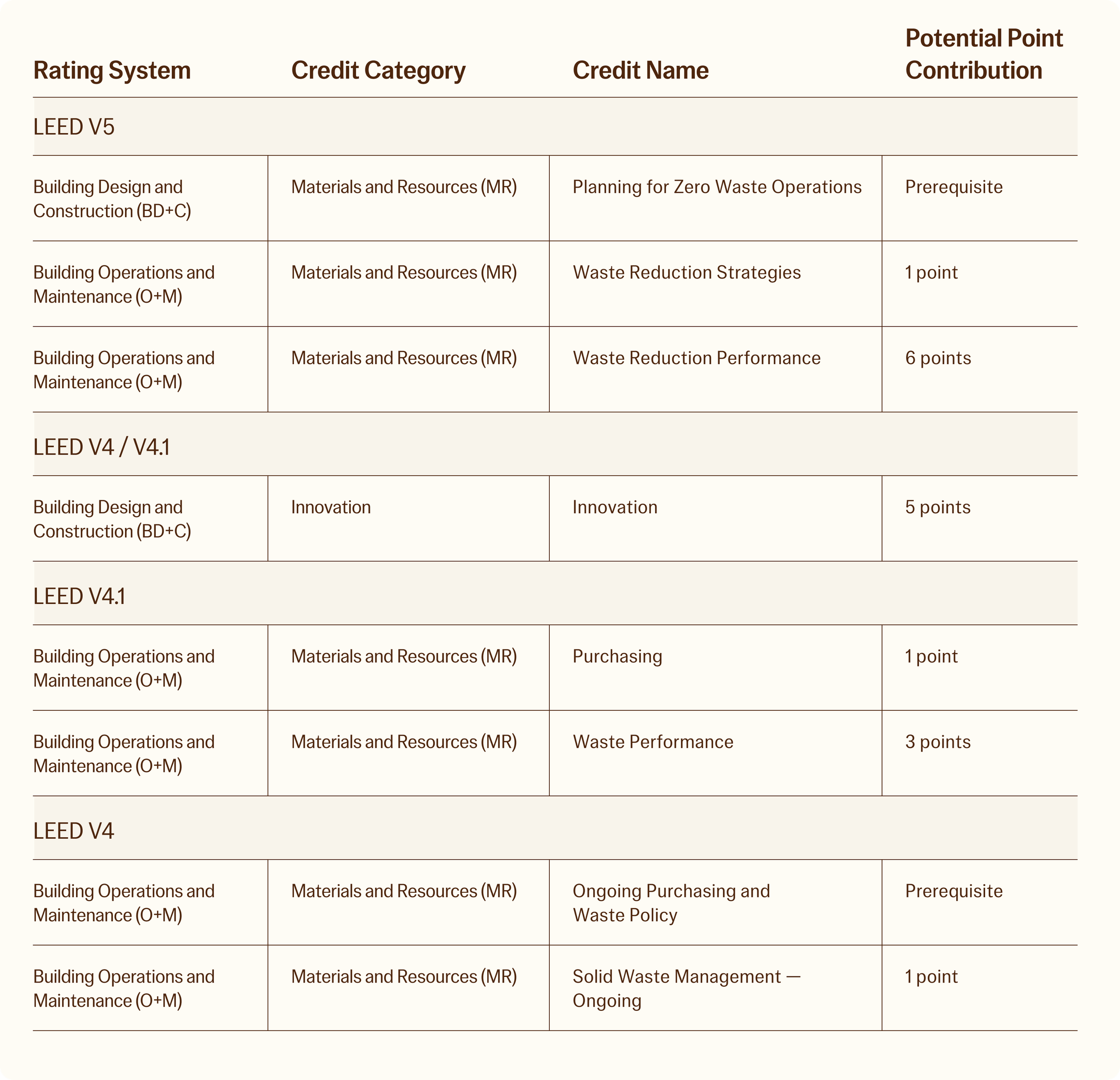
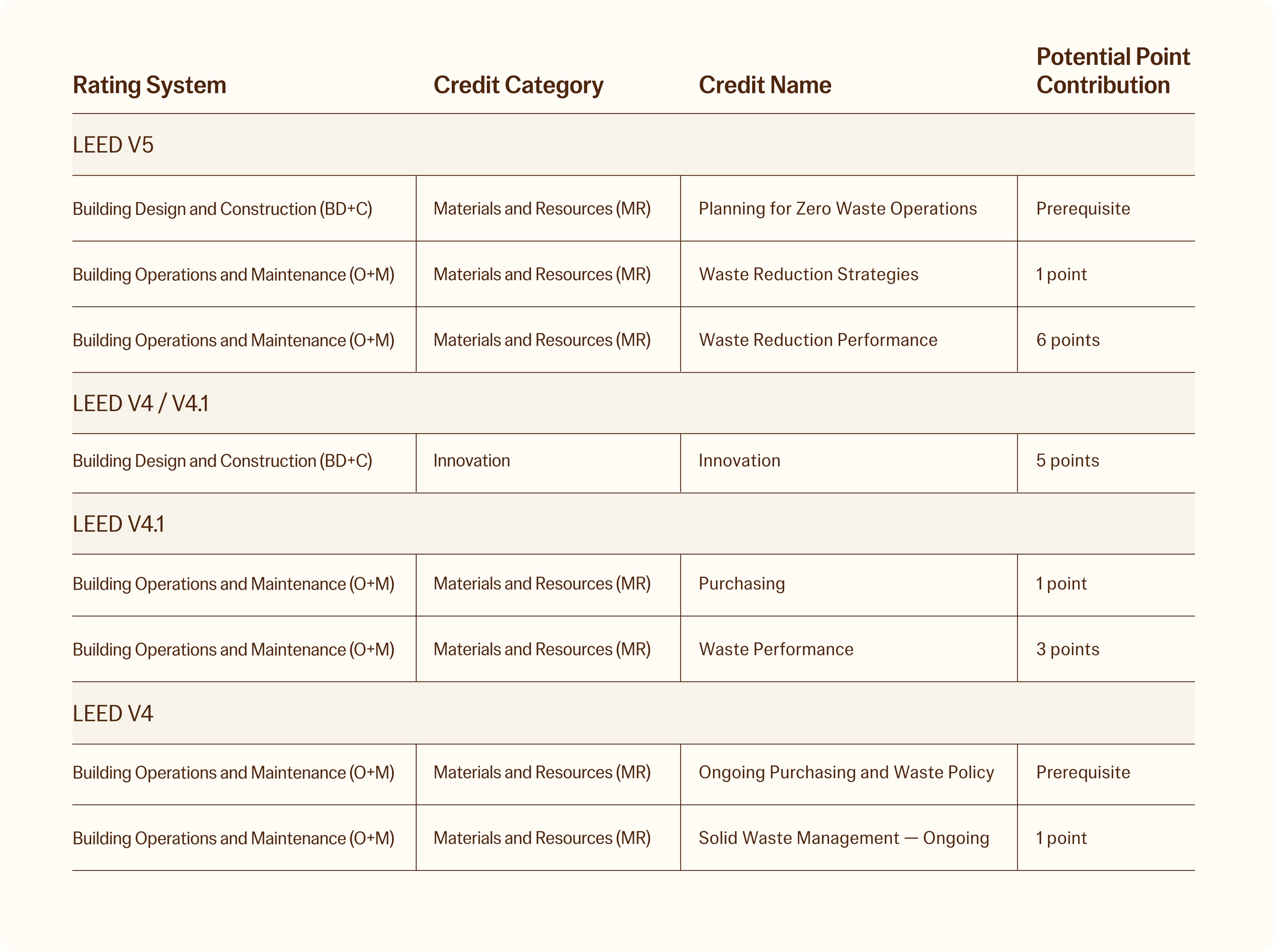
Mill can help earn points across the latest LEED versions. For the most recent v5 version, Mill fulfills a prerequisite for new construction projects (Building Design and Construction, or BD+C) and can support up to 7 points for existing building projects (Building Operations and Maintenance, or O+M).
Materials and Resources (MR) Credit | Planning for Zero Waste Operations | Prerequisite (for certification)
Mill can contribute waste minimization goals and strategies for the project to divert waste post-occupancy by enabling a plan for food recycling and circularity during operations.
Materials and Resources (MR) Credit | Waste Reduction Strategies | 1 point
Mill delivers a waste prevention and composting program that includes training, appropriate signage, and implementation guidance for effectively minimizing contamination and maximizing diversion of food scraps from disposal to farms.
Materials and Resources (MR) Credit | Waste Reduction Performance | Up to 6 points (assuming food scraps are 36% of stream)
Mill measures the amount of food scraps (by weight) generated by building operations and diverts them from disposal. Mill provides monthly reporting and can also facilitate a waste audit and develop a baseline of food scraps generated by building operations before and after deploying a fleet of Mill food recyclers over a 12-month period.
Innovation (IN) Credit | Innovation | Up to 5 points
Mill contributes to pilot credits from USGBC’s LEED Pilot Credit Library required to achieve the Innovation credit:
Comprehensive Composting: Mill provides infrastructure for onsite storage, processing, and diversion of food scraps from landfill.
Circular Products: Mill offers refurbished Mill food recyclers and contracts through a products-as-a-service model, which includes take-back and cycling of Mill food recyclers at the end of use.
Materials and Resources (MR) Credit | Purchasing | 1 point
Mill is directly responsible for extended producer responsibility and supports environmentally preferable purchasing (EPP) policies.
Materials and Resources (MR) Credit | Waste Performance | Up to 3 points (assuming food scraps are 36% of stream)
Mill measures the total weight of food scraps added to a building’s fleet of Mill food recyclers, and the total weight that is diverted from landfills and incineration facilities for one full year.
Materials and Resources (MR) Credit | Ongoing purchasing and waste policy | Prerequisite (for certification)
Mill enables composting of food scraps generated during regular operations of a building in line with high-performing solid waste management policies.
Materials and Resources (MR) Credit | Solid waste management - ongoing | 1 point (assuming food scraps are 36% of stream)
Mill enables diversion of food scraps that can account for 30-40% of ongoing waste (by weight and volume)
Buildings that are already LEED Certified (BD+C or O+M), have 12 months of operating data, and achieve TRUE Zero Waste Platinum Certification can receive a complementary LEED Zero Waste Certification. Mill can contribute by boosting a building’s application for TRUE Zero Waste Certification (below).
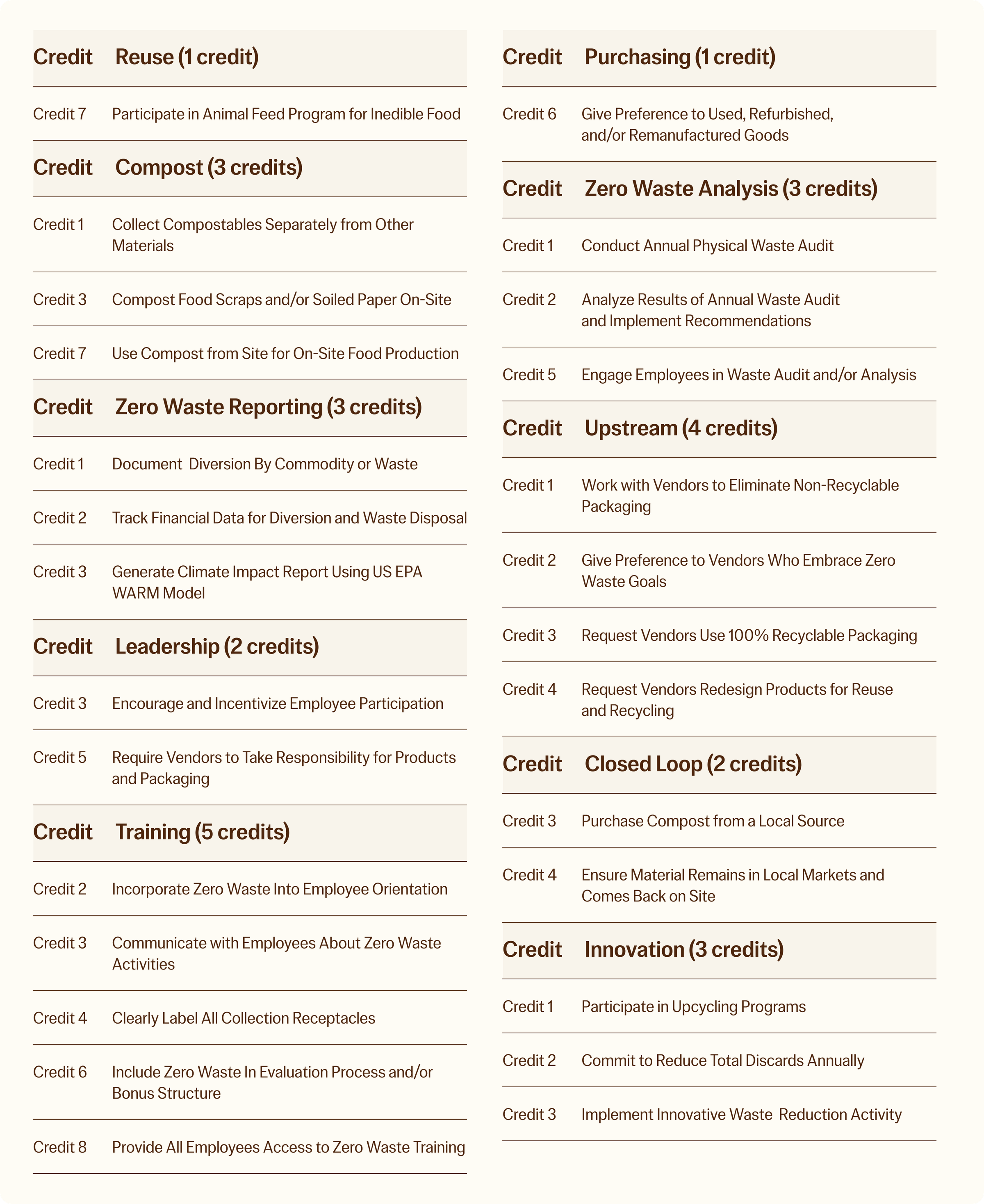
Mill food recyclers can significantly contribute to TRUE certification credits (up to 27 credits, or the difference between a TRUE Silver and a TRUE Platinum score).
Mill transforms food scraps into a nutrient-rich ingredient for commercial chicken feed. Customers place food scraps into a Mill food recycler, which dries and grinds the material overnight. Once ready, the dry grounds are shipped to Mill’s feed manufacturing facility, where they’re screened and processed into a commercial feed ingredient. Most of this feed currently goes to Wilcox Farms in Roy, WA, and other local farms, where it’s incorporated into the diets of egg-laying hens. Mill holds a commercial feed license in Washington, earned through collaboration with the FDA, AAFCO, feed nutritionists, and research institutions to ensure the ingredient’s safety and quality.
Reuse Credit 7: Participate in Animal Feed Program for Inedible Food
Mill makes it simple to separate food scraps at the source and minimize contamination. Each unit is clearly labeled with what can and can’t be added, making proper use straightforward. The recyclers transform food scraps and soiled paper into compact, odor-minimized, shelf-stable grounds that can be used in on-site composting systems or incorporated into gardens and landscaping.
Compost Credit 1: Collect Compostables Separately From Other Materials
Compost Credit 3: Compost Food Scraps and/or Soiled Paper On-Site
Compost Credit 7: Use Compost From Site For On-Site Food Production
Mill automatically measures and tracks the amount of food scraps added over time, and uses the EPA WARM model to estimate greenhouse gas reductions from each bin. Customers receive monthly impact reports that show total food diverted from the landfill across their fleet. See Mill's 2025 LCA for more information.
Zero Waste Reporting Credit 1: Document Diversion By Commodity or Waste
Zero Waste Reporting Credit 2: Track Financial Data for Diversion and Waste Disposal
Zero Waste Reporting Credit 3: Generate Climate Impact Report Using US EPA WARM Model
Mill’s product-as-a-service model includes end-of-use takeback and recycling, with refurbished and remanufactured units available.
Purchasing Credit 6: Give Preference to Used, Refurbished, and/or Remanufactured Goods
Employees can track the amount of food scraps they add over time and see how their individual impact compares with their colleagues. Customers receive reports summarizing the total mass of food scraps diverted across all participating employee households, providing insight into collective impact and engagement.
Mill uses 100% recyclable corrugated cardboard and paper pulp material for packaging. To ensure product protection and an accessible unboxing experience, some recyclable plastic components are also used, which can be recycled where facilities exist.
Leadership Credit 3: Encourage and Incentivize Employee Participation
Leadership Credit 5: Require Vendors to Take Responsibility for Products and Packaging
Mill provides signage, communications, surveys, and educational sessions to help customers engage employees around reducing food waste in the workplace and ensuring food scraps are diverted from landfills to their highest and best use. Discounts for employees looking to purchase a Mill for their homes incentivises sustainable behavior beyond the workplace. Employers may decide to offer additional recognition and compensation for employees who choose to participate and engage with their food recycling program with Mill.
Training Credit 2: Incorporate Zero Waste Into Employee Orientation
Training Credit 3: Communicate with Employees About Zero Waste Activities
Training Credit 4: Clearly Label All Collection Receptacles
Training Credit 6: Include Zero Waste In Evaluation Process and/or Bonus Structure
Training Credit 8: Provide All Employees Access to Zero Waste Training
Mill customers can use impact data alongside a physical waste audit data to compare food scrap volume found in their trash stream, estimate landfill diversion rates, and evaluate the overall performance of zero waste programs. This data can be used to identify opportunities to increase diversion, reduce contamination, and prevent waste at the source. Data can be shared with employees to encourage participation and celebrate impact.
Zero Waste Analysis Credit 1: Conduct Annual Physical Waste Audit
Zero Waste Analysis Credit 2: Analyze Results of Annual Waste Audit and Implement Recommendations
Zero Waste Analysis Credit 5: Engage Employees in Waste Audit and/or Analysis
Founded in 2020, Mill is a public benefit corporation with a mission to promote environmental conservation by reducing the amount of unnecessary material sent to landfills and making waste easier to manage. Mill uses 100% recyclable corrugated cardboard and paper pulp packaging for shipping, with a few recyclable plastic components included to protect the units and simplify unboxing where accepted by local programs. Our product-as-a-service model also includes product takeback and recycling at the end of use, extending each unit’s life and minimizing waste.
Upstream Credit 1: Work with Vendors to Eliminate Non-Recyclable Packaging
Upstream Credit 2: Give Preference to Vendors Who Embrace Zero Waste Goals
Upstream Credit 3: Request Vendors Use 100% Recyclable Packaging
Upstream Credit 4: Request Vendors Redesign Products for Reuse and Recycling
The dry grounds produced by the Mill food recycler share many of the same qualities as organic matter–based soil amendments. Rich in the nutrients plants need to grow, they also provide an excellent source of soil organic matter—material derived from once-living plants and animals that supports long-term soil health. While the dry grounds aren’t the same as finished compost, they can offer similar benefits when managed properly. Customers can use the dry grounds directly on-site or partner with a local composter to turn them into finished compost for future use.
Closed Loop Credit 3: Purchase Compost from a Local Source
Closed Loop Credit 4: Ensure Material Remains in Local Markets and Comes Back on Site
Mill provides an innovative solution for employees and tenants to turn food scraps into a safe, nutritious ingredient for commercial chicken feed or gardens. Studies have found that the median amount of food scraps added to Mill decreases over time - by over 20% in the first four months.
Innovation Credit 1: Participate in Upcycling Programs
Innovation Credit 2: Commit to Reduce Total Discards Annually
Innovation Credit 3: Implement Innovative Waste Reduction Activity
The Mill food recycling solution offers commercial property stakeholders a powerful tool for earning points toward achieving and maintaining both LEED and TRUE certifications. By addressing food waste—a significant component of commercial waste streams—Mill delivers measurable environmental benefits while contributing directly to certification points and credits. The integration of Mill into commercial properties represents a forward-thinking approach to waste management that aligns with the sustainability goals of LEED and TRUE certification programs.
Mill is a member of US Green Building Council (USGBC) and consulted their marketing and client relations teams to compile the this document.
Unlock exclusive USGBC pricing.
Enter your email to get exclusive pricing for your building. This offer is available for U.S. Green Buildings Council members.